Key Takeaways
- Constantine did not invent the divinity of Jesus. The Council of Nicea (325 AD) was convened to clarify what Christ’s divinity meant in response to the Arian controversy — not to introduce a new teaching.
- Christians were already worshipping Jesus as God over 200 years before Nicea. Pliny the Younger reported this to Emperor Trajan around 112 AD, and Ignatius of Antioch called Jesus “our God” while being taken to his martyrdom in the early 2nd century.
- Before Constantine ever favoured Christianity, the church had already survived over 250 years of state persecution under emperors including Nero, Decius, Valerian, and Diocletian.
- Constantine came to favour Christianity after attributing his unlikely victory at the Battle of the Milvian Bridge (312 AD) to the Christian God.
- The Nicene Creed’s declaration that Jesus is “of one Being with the Father” (Greek: homoousios) was a direct refutation of Arius — not a new invention, but a precise statement of what the church already believed.
The Claim
I often talk to most Muslims and atheists and they usually say things like Constantine & the Council of Nicea came up with the trinity and also Constantine changed the things in the Bible, of which the latter would be discussed in another blog — but here we would focus on the former.
Before Constantine: A Church Under Persecution
Before we talk about Constantine, we will go way back. Before Constantine became emperor, Christians went through massive persecution. According to Tacitus, the first wave of organised persecution occurred under Nero (r. 54–68), who blamed Christians for the Great Fire of Rome in 64.
Persecution of Christians was still ongoing in the Roman Empire, and the Decian persecution was particularly extensive, because Decius wanted to restore the Roman golden age and he did this by forcing pagan practices upon the Christian community. Another wave of persecution began under Valerian (r. 253–260), but ceased abruptly after he was captured and taken prisoner by the Sasanian Empire during the Battle of Edessa of the Roman–Persian Wars. Under his successor Gallienus (r. 253–268), whose reign was marred by rapidly escalating military conflicts of the Crisis of the Third Century, the first ever decree of tolerance was issued for Christian practices and places of worship, although it stopped short of recognising Christianity as a religion with legal status.
Then Emperor Diocletian (r. 283–305) began the Diocletianic persecution, which was the final and the most severe wave of persecution of Christians by the Roman state.
This context matters enormously. The divinity of Jesus was not a teaching that emerged peacefully from a council chamber. It was a conviction that Christians had been dying for — under torture, in arenas, and at the stake — for over two centuries before Constantine ever walked into Nicea.
Diocletian’s Tetrarchy and the Final Persecution
By the early 300s, the Roman Empire had grown too large for one man to rule, so a system was established by Emperor Diocletian to manage the vast empire by dividing power among two senior emperors (Augusti) and two junior emperors (Caesares), so the Roman Empire was governed by the Tetrarchy (“rule of four”). Also this system was intended to end the wars of succession that had been happening in the Roman Empire.
So by 305, Galerius and Maximinus ruled in the East while Constantine’s father and Severus ruled the West.
Constantine’s Rise: An Unexpected Emperor (306 AD)
But on 25th July 306 AD, in Britain, one of the emperors — Constantius Chlorus — died unexpectedly. And almost immediately his armies took matters into their own hands and made his son Constantine the Great the next emperor, defying the legitimate succession plans set out by Diocletian, because Constantine wasn’t next in line — it was supposed to be Maxentius.
So Maxentius felt cheated and declared himself next emperor, and it led to many wars.
Constantine’s rise was irregular from the start — not a legal transfer of power but a military acclamation. His path to sole rule of the empire would take another eighteen years of civil war, alliances, and betrayal.
The Edict of Serdica and the Collapse of the Tetrarchy (311 AD)
In early May 311 AD, after the death of the Roman Emperor Galerius (who was the senior Augustus of the Eastern Roman Empire), the tetrarchy then collapsed. However, just days before his death in April 311 AD, Emperor Galerius issued the Edict of Serdica (also known as the Edict of Toleration), which officially ended the Diocletianic Persecution of Christians in the Eastern Roman Empire.
And this was a shocking reversal because Galerius had previously been the primary instigator and most brutal executor of the Great Persecution.
Also before his death, Galerius most likely helped Licinius to become senior emperor (Augustus).
And in late 311 or early 312 AD, Constantine joined forces with Licinius, while Maxentius stood alone.
The Battle of the Milvian Bridge (October 28, 312 AD)
By October 28, 312 AD, Constantine went to battle with Maxentius and he won. This battle is commonly known as the Battle of the Milvian Bridge because after Constantine’s army broke Maxentius’s, remnants of Maxentius’s army in their confused attempt to flee back overloaded the pontoon bridge which was built across the Tiber river some distance from the Milvian Bridge, causing many men — including Maxentius — to fall into the river and drown.
Constantine then believed it was the Christian God that helped him win the battle, because mind you, during the battle between Constantine & Maxentius, Constantine had fewer armies than Maxentius. So Constantine didn’t just win — he won against the odds.
Two Accounts of What Constantine Saw
On the eve of this battle, something happened, and two 4th-century Christian writers — Lactantius and Eusebius of Caesarea — provide slightly different accounts of the events.
According to Lactantius’s De mortibus persecutorum (“On the Deaths of the Persecutors”), Lactantius states that on the night before the battle, Constantine was commanded in a dream to “delineate the heavenly sign on the shields of his soldiers.” He followed the commands of his dream and marked the shields with a sign “denoting Christ” — specifically a form of the Chi-Rho monogram. Lactantius describes that sign as a “staurogram”, or a Latin cross with its upper end rounded in a P-like fashion. There is no certain evidence that Constantine ever used that sign, as opposed to the better known Chi-Rho sign described by Eusebius.
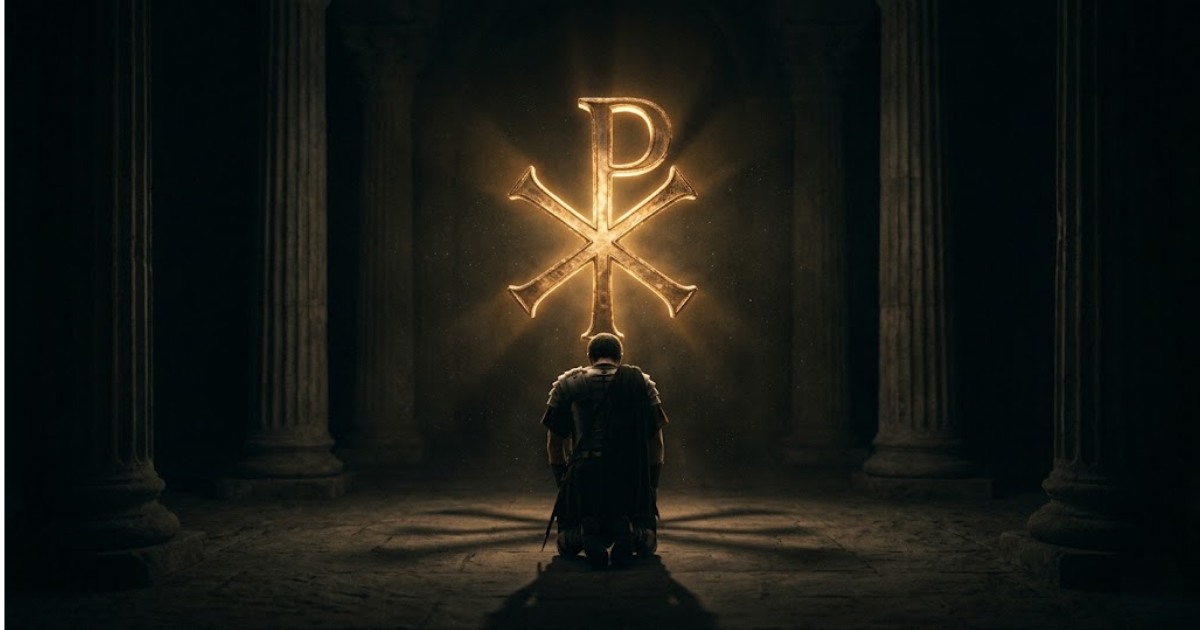
From Eusebius, two accounts (the Historia ecclesiastica and the Vita Constantini) of the battle survive. The first, shorter one in the Ecclesiastical History promotes the belief that the Christian God helped Constantine but does not mention any vision. In his later Life of Constantine, Eusebius gives a detailed account of a vision and stresses that he had heard the story from the Emperor himself. According to this version, Constantine with his army was marching when he looked up to the sun and saw a cross of light above it, and with it the Greek words “💡Εν Τούτωι Νίκα” (En toutōi níka), usually translated into Latin as “in hoc signo vinces.” The literal meaning of the phrase in Greek is “in this (sign), conquer,” while in Latin it’s “in this sign, you shall conquer.” At first he was unsure of the meaning of the apparition, but in the following night he had a dream in which Christ explained to him that he should use the sign against his enemies. Eusebius then continues to describe the labarum, the military standard used by Constantine in his later wars against Licinius, showing the Chi-Rho sign.
The Edict of Milan: Christianity Legalised (February 313 AD)
So Constantine began to favour Christians in his empire. And by February 3rd, 313, Constantine and Licinius issued an edict legalising Christianity in the empire, and also confiscated church properties were returned.
The Edict of Milan did not make Christianity the official state religion of Rome — that would come later under Emperor Theodosius I in 380 AD. What it did was end centuries of state-sanctioned persecution and grant Christians the same legal standing as any other religious group in the empire.
However, tension began to grow between Constantine and Licinius and it led to two major civil wars: the first in 316–317 and then in 324 AD.
The Arian Controversy: The Crisis That Called for a Council
After Constantine’s victory over Licinius in 324 AD, while he was establishing his administration in the East, he found out about the “Arian controversy.”
So in Alexandria, a priest named Arius was teaching that Jesus is not eternal, Jesus was created by the Father, and Jesus is not equal to the Father. Arius’s slogan was: “there was a time when the Son was not.” This teaching was called Arianism.
And his teaching spread rapidly, causing division across the empire, and this conflict threatened the church unity and even the political unity.
Arianism was not a fringe position — it attracted significant support from bishops across the Eastern Empire and became a serious theological fault line. The fact that Arius needed a council to refute him is itself evidence that the divinity of Christ was already the established position of the church. You do not hold a council to establish something new. You hold a council to defend something old against a challenge.
At first Constantine wrote a letter to Arius asking for unity, but when it failed, Constantine called the first ecumenical council — a worldwide gathering of Christian bishops to resolve this matter. And this was referred to as the Council of Nicea and it was held in 325 AD.
The Council of Nicea (325 AD) and the Nicene Creed
At this gathering they agreed on a date of Easter, and also drafted the Nicene Creed:
We believe in one God,
the Father, the Almighty,
maker of heaven and earth,
of all that is, seen and unseen.
We believe in one Lord, Jesus Christ,
the only Son of God,
eternally begotten of the Father,
God from God, Light from Light,
true God from true God,
begotten, not made,
of one Being with the Father.
Through him all things were made.
For us and for our salvation
he came down from heaven:
by the power of the Holy Spirit
he became incarnate from the Virgin Mary,
and was made man.
For our sake he was crucified under Pontius Pilate;
he suffered death and was buried.
On the third day he rose again
in accordance with the Scriptures;
he ascended into heaven
and is seated at the right hand of the Father.
He will come again in glory to judge the living and the dead,
and his kingdom will have no end.
We believe in the Holy Spirit, the Lord, the giver of life,
who proceeds from the Father [and the Son].
With the Father and the Son he is worshiped and glorified.
He has spoken through the Prophets.
We believe in one holy catholic and apostolic Church.
We acknowledge one baptism for the forgiveness of sins.
We look for the resurrection of the dead,
and the life of the world to come. Amen.
Then Arius and his chief supporters were exiled (though Arius was later temporarily readmitted by Constantine’s goodwill).
The Creed Clarified — It Did Not Invent
The Nicene Creed wasn’t about drafting the divinity of Jesus but clarifying what the divinity of Jesus meant, since it was already known to the church.
This is the critical distinction the claim always misses. You do not need to “invent” the divinity of Christ at a council held in 325 AD when you can point to Christians being martyred for that exact belief under Nero in 64 AD — over 260 years earlier. The Nicene Creed is a theological precision tool, not a creation act. It defined the language of an existing conviction against a specific denial.
Witnesses to Christ’s Divinity Before Constantine and Nicea
And even earlier writers confirm this. Pliny the Younger (c. 112 AD) in a letter to Emperor Trajan described Christians:
“They were accustomed to meet on a fixed day before dawn and sing responsively a hymn to Christ as to a god.” — Pliny the Younger, Epistulae X.96 (c. 112 AD)
Also, Ignatius of Antioch (early 2nd century) directly called Jesus:
“our God, Jesus Christ” — Ignatius of Antioch, Letter to the Ephesians (c. 107–110 AD), written while on the way to martyrdom
Pliny the Younger was not a Christian. He was a Roman governor writing to his emperor about a religious group he was investigating. His testimony is the testimony of an outsider — a hostile witness, in legal terms. And what he reports is that Christians were worshipping Jesus as God at the turn of the 2nd century, more than two hundred years before Nicea.
Ignatius of Antioch wrote his letters while being transported under military guard to Rome to be executed. He was not writing comfortable theology in a palace. He was a man about to die, and his letters are saturated with the language of Christ as God — not as a council decree, but as the living conviction for which he was about to give his life.
The divinity of Jesus did not come from Constantine, or any council. It came from Christ himself — revealed in his incarnation, confirmed in his resurrection, and proclaimed by those who witnessed it firsthand. The church preserved and defended that truth through two and a half centuries of Scripture, preaching, worship, and martyrdom. Constantine simply stopped killing them for it.
Frequently Asked Questions
Did Constantine invent the divinity of Jesus at the Council of Nicea?
No. The Council of Nicea (325 AD) was convened to clarify what Christ’s divinity meant — not to create it. Christians were already worshipping Jesus as God over 200 years before Nicea. Pliny the Younger wrote to Emperor Trajan around 112 AD that Christians “sing responsively a hymn to Christ as to a god.” Ignatius of Antioch, writing in the early 2nd century, directly called Jesus “our God, Jesus Christ” in letters written while being taken to his martyrdom.
What was the Arian controversy that led to the Council of Nicea?
Arianism was the teaching of Arius, a priest in Alexandria, who claimed that Jesus is not eternal — that Jesus was created by the Father, is not equal to the Father, and that “there was a time when the Son was not.” This spread rapidly across the empire, threatening both church unity and political unity. Constantine initially tried to resolve it by letter; when that failed, he called the Council of Nicea in 325 AD.
What did the Edict of Milan actually do?
The Edict of Milan, issued by Constantine and Licinius on February 3, 313 AD, legalised Christianity throughout the Roman Empire and ordered the return of confiscated church properties. It did not make Christianity the official state religion — that happened under Emperor Theodosius I in 380 AD — but it ended state persecution and granted Christians equal legal standing.
What is the Nicene Creed?
The Nicene Creed is a statement of Christian faith drafted at the Council of Nicea in 325 AD. It affirms that Jesus is “eternally begotten of the Father, God from God, Light from Light, true God from true God, begotten, not made, of one Being with the Father.” The phrase “of one Being with the Father” (Greek: homoousios) directly refuted Arius’s claim that the Son was a created being of a different substance than the Father.
What happened to Arius after the Council of Nicea?
Arius and his chief supporters were exiled following the Council of Nicea. However, later in Constantine’s reign, Arius was temporarily readmitted by Constantine’s goodwill. The Arian controversy continued for decades after Nicea and was addressed again at the Council of Constantinople in 381 AD.