Key Takeaways
- Jews considered their Hebrew writings sacred long before the Bible was formally compiled — the Babylonian exile (586 BC) began a centuries-long linguistic transformation that shaped how Scripture was preserved.
- When Alexander the Great spread Greek culture across the ancient world, diaspora Jews lost their native Hebrew and needed a translation — producing the Septuagint, with its legendary 72 translators.
- The Hebrew Bible (Tanakh) was compiled between approximately 450 BC and 100 AD across three sections — Torah, Nevi’im, and Ketuvim — using criteria including prophetic attribution, consistency with the Torah, antiquity, and liturgical usage.
- The Masoretes (7th–10th century AD) added vowel markings to the Hebrew text, producing the Masoretic Text — oldest complete copy: the Leningrad Codex (1009 CE).
- The Dead Sea Scrolls (discovered 1947, dated 250 BCE–70 CE) show ~95% agreement with the Masoretic tradition, confirming over a millennium of faithful scribal transmission.
How It All Began: Hebrew Writings Before the Bible Was Compiled
Many people might have the question of how did we know which book goes into the Bible.
In this blog we will discuss how the Old Testament came into being.
So let’s go all the way back.
Jews were Hebrew speakers and they considered some Hebrew writings (like the law, traditions, prophets) sacred even before the Hebrew Bible was completely compiled.
This is a critical starting point: the sacredness of these texts was not a later invention by religious councils or political authorities. It was a lived community conviction that preceded any formal canonisation process by centuries.
The Babylonian Exile and the Aramaic Influence (586 BC)
In 586 BC, Babylon carried away many Jews (particularly those from the southern kingdom / kingdom of Judah). This period marked the destruction of the first temple and of Jerusalem itself.
After their exile to Babylon, the Jews also learnt to speak Aramaic because that was what the Babylonians spoke, and that is the reason why part of the Old Testament was written in Aramaic — like part of Daniel & Ezra and the verse Jeremiah 10:11.
The destruction of Solomon’s Temple was the defining rupture of early Jewish history, carried out by Nebuchadnezzar II. It forced an entire people into sustained contact with a foreign empire and its language — and that contact left a permanent mark on the sacred texts they carried into exile.
The Persian Period (539 BC)
Then by 539 BC, Babylon was conquered by the Medo-Persian Empire, who also spoke Aramaic.
Under the Persian king Cyrus the Great, many Jews were permitted to return to Judah — a return described in the books of Ezra and Nehemiah. But even as communities resettled, Aramaic remained the dominant administrative language of the empire, continuing to shape how the Jewish community read, wrote, and transmitted its scriptures.
Alexander the Great and the Hellenisation of the World (334–330 BC)
By 334 BC and 330 BC, Alexander the Great then conquered the Persian Empire including Judea & Egypt. So he spread the Hellenistic (Greek) culture. And this began a period called hellenisation — which was a deep cultural and linguistic transformation.
So the Jews had to adopt the Greek language because that was the only way they could interact.
Hellenisation was not merely a political conquest — it was a wholesale reordering of the ancient world’s cultural assumptions. Greek became the language of philosophy, commerce, literature, and public life. Within a generation, communities that had spoken Aramaic for a century found themselves needing to operate in yet another language.
The Wars of the Diadochi: The Fragmented Empire (323 BC)
In 323 BC, Alexander the Great died and he didn’t name a successor. Also his half-brother Philip III was mentally impaired and his infant son Alexander IV was too young. So this led to a series of wars between Alexander’s top generals and governors over Alexander’s empire, and these wars were referred to as the Wars of the Diadochi (successors). And it caused the empire to be divided, and the main kingdoms were: the Ptolemies (ruled Egypt) around 320 BC, the Seleucids (ruled Syria–Mesopotamia) around 198 BC, and the Antigonids (ruled mainland Greece and Macedonia).
All three successor kingdoms maintained Greek as the language of power and culture. Hellenisation became institutionalised. For Jewish communities scattered across these kingdoms, Greek was no longer a foreign conqueror’s tongue — it was the language of everyday survival.
The Septuagint: Hebrew Scriptures in Greek
Now because of the widespread use of Greek, Jews living outside of Judea — particularly in Alexandria, Egypt — lost their native Hebrew almost entirely. And as a result of that they needed their Hebrew writings (like the Torah, prophetic writings, Psalms, historical writings) to be translated to Greek, and that is what we call the Septuagint text. Septuagint means “seventy” and according to legend about 72 Jewish translators independently produced identical translations.
The legend of the 72 translators is preserved in the Letter of Aristeas, a Jewish text from around the 2nd century BC, which describes Ptolemy II Philadelphus commissioning the translation in Alexandria. Whether or not every detail of the legend is historical, the Septuagint became the authoritative scripture for Jewish communities throughout the Hellenistic world — and for the early Christian church. This is why Old Testament passages most quoted in the New Testament are typically in the Septuagint form.
The Deuterocanonical Books
The Septuagint didn’t only include translations of the Hebrew writings. During the Jews’ stay in Greece and under Roman conquest, some additional Jewish writings (like Tobit, Judith, Wisdom of Solomon, Sirach, Baruch, 1–2 Maccabees, additions to Daniel and Esther, Prayer of Manasseh, Psalms 151, 1 Esdras) which were written in Greek or preserved mainly in Greek, were included. These additional writings were known as the deuterocanonical books or the Apocrypha.
These books occupy different canonical status across Christian traditions. Catholic and Eastern Orthodox churches include them as fully inspired Scripture. Protestant traditions, following the Hebrew canon, generally treat them as secondary — a distinction that traces back in part to Jerome’s own stated position, addressed below.
The Tanakh: The Three Sections of the Hebrew Bible (450 BC–100 AD)
However, we have to know that between 450 BC and 100 AD, the first Hebrew Bible was compiled, and of course it was not a one-time thing, and that was why it took that long. And the Jews had some criteria for compiling the Hebrew Bible:
- Attribution to a prophet or king
- Consistency with the Torah
- Antiquity
- Liturgical usage
This Hebrew Bible is also referred to as the Tanakh because it represented the three sections of the Hebrew Bible.
A. Torah (“Law”)
The five books of Moses.
B. Nevi’im (“Prophets”)
Included:
C. Ketuvim (“Writings”)
Included:
- Psalms
- Proverbs
- Job
- Daniel
- Ezra-Nehemiah
- Chronicles
- Song of Songs
- Ruth
- Lamentations
- Ecclesiastes
- Esther
Rome Conquers Greece — But Greek Endures (146 BC)
Anyways, back to the Greeks. By 146 BC, Rome conquered Mainland Greece. And although the Romans conquered Greece, they still adopted Greek culture. In fact a Roman poet Horace famously wrote:
“Captive Greece took captive her savage conqueror.” (Graecia capta ferum victorem cepit) — Horace
So in Rome, Greek was still the prominent language, so the apostles and early church fathers often used the Septuagint, and that is why the Old Testament most quoted in the New Testament is usually the Septuagint form.
When New Testament writers like Paul quote the Old Testament, they are frequently citing the Greek Septuagint — not the Hebrew text directly. The Septuagint was, for the first-century church, the scripture the world could read.
The Maccabean Revolt and the Road to Roman Judea
However, the Seleucid kingdom particularly over the territory of Judea was still in rule until the Maccabean Revolt, which was led by Mattathias and his son Judas Maccabeus, and this brought about Jewish independence for about 80 to 100 years before they were again conquered by Rome in 63 BC.
By 64 BC Rome conquered Syria, and by 30 BC Rome conquered the Ptolemies, making Rome in charge of world power.
As Roman legions conquered new territories, they established colonies (veteran settlements) that served as focal points for the spread of Latin language and culture. So Latin became the language of law, government, and business throughout the empire. To participate in government, secure legal rights, or trade with Romans, local populations had to learn the language.
The Maccabean Revolt — which gave rise to the festival of Hanukkah — was triggered by the Seleucid king Antiochus IV Epiphanes’s attempt to forcibly suppress Jewish religious practice and desecrate the Temple. The revolt succeeded. But by 63 BC, the Roman general Pompey entered Jerusalem, and Judea became a client state of Rome.
Latin Enters the Picture: The Vetus Latina
As Christianity spread westward, Latin became dominant. And the first Latin translation of the Old and New Testament was called Latin Vetus or Old Latin, and it was made in the late second to early third centuries. For the Old Testament, it was the Septuagint (Greek translation of the Hebrew text) that was translated into the Old Latin. By the end of the third century, all of the Old and New Testament writings had been translated into Latin.
Now because the Vetus Latina translations were not produced systematically by a central authority but were the work of various translators and communities, it resulted in numerous versions of the scriptures, often of uneven quality. Speaking of the faults of the Vetus Latina, St. Jerome said in his preface to his translation of the Gospels:
“...the text was either badly rendered by stupid translators, or awkwardly changed by meddlesome but incompetent revisers, or either interpolated or twisted by sleepy copyists.” — St. Jerome (Steinmueller, S.T.D., S.Scr.L., “The Pre-Jerome Latin Version.” 1040)
Jerome and the Latin Vulgate
As a result of this, Pope Damasus I commissioned Jerome in the late 4th century AD to produce a better Latin Bible. And this was referred to as the Latin Vulgate.
Jerome did this by comparing the various Latin readings and correcting them as necessary to correspond to the Greek text available to him. He completed this work on the Gospels prior to Damasus’s death in AD 384, after which Jerome turned his attention to the Old Testament, producing a fresh translation of the Hebrew Bible into Latin. The remainder of the New Testament seems to have been translated in the early fifth century. Some surmise that the other books of the New Testament were revised by St. Jerome’s associate, Rufinas (Kselman 1320), but others say that Jerome translated them himself. (Steinmueller, D.D., S.Scr.L. 254)
Jerome also translated the deuterocanonical books of Tobias (Tobit) and Judith from Aramaic originals, but Wisdom, Ecclesiasticus (Sirach), Baruch and Maccabees I and II were left untranslated from the Vetus Latina by St. Jerome (Steinmueller, D.D., S.Scr.L. 256), a fact that St. John Paul would later mention when promulgating the Nova Vulgata in 1979 (Scripurarum Thesaurus | St. John Paul II). The other deuterocanonical books (Wisdom of Solomon, Sirach (Ecclesiasticus), Baruch, First Maccabees, Second Maccabees, Greek additions to Daniel and Esther) in the Vulgate were mostly inherited from earlier Old Latin translations.
In Jerome’s famous Prologus Galeatus (“Helmeted Preface”), he said books outside the Hebrew canon should be read for edification but not for establishing doctrine in the same way as canonical Scripture.
However, despite Jerome’s opinion, these books were still used by the wider western church liturgically and scripturally.
Jerome took the additions to the Book of Daniel from Theodotian, a Hellenistic Jewish scholar who translated the Hebrew Bible into Greek in 150 AD, and additions to Esther from the Septuagint. (Steinmueller, D.D., S.Scr.L. 253–256)
The Vulgate would remain the authoritative Bible of the Western church for over a thousand years — a testament to the quality of Jerome’s scholarship and the stability of the texts he was working from.
The Masoretes and the Masoretic Text (7th–10th Century AD)
Between the 7th and 10th century AD, there was a group of Jews known as the Masoretes. Since the ancient Hebrew writings mostly used consonants only, the Masoretes added:
- Vowel markings
- Pronunciation guides
- Accent marks
- Copying notes
...to the Hebrew Bible (the Tanakh). And this was referred to as the Masoretic Text.
The oldest known complete copy of the Masoretic Text is the Leningrad Codex, which dates to 1009 CE. The Aleppo Codex dates to around 930 CE (slightly earlier but partially damaged).
The Masoretes were not editing the text — they were stabilising it. By adding a standardised vowel system and meticulous copying notes, they created a transmission mechanism of extraordinary precision. The Masoretic Text became the foundation for virtually all modern Protestant Old Testament translations, including the King James Version.
The Dead Sea Scrolls: The 1947 Discovery That Confirms Everything
By 1947, over 800 Jewish manuscripts from Qumran (11 caves), including fragments of every Old Testament book except Esther, were discovered in jars in a cave at Qumran north of the Dead Sea, and these were called the Dead Sea Scrolls. And these scrolls had manuscripts dating roughly from the 3rd century BCE to the 1st century CE (about 250 BCE–70 CE).
Scholars often say the Dead Sea Scrolls show very high agreement with the later Masoretic tradition — sometimes around 95% in certain books like Isaiah — and most differences are minor, such as:
- Spelling variations
- Word order
- Grammatical forms
- Scribal slips
- Minor additions/omissions
- Orthographic differences (full vs. defective spelling)
But this does not change the meaning substantially.
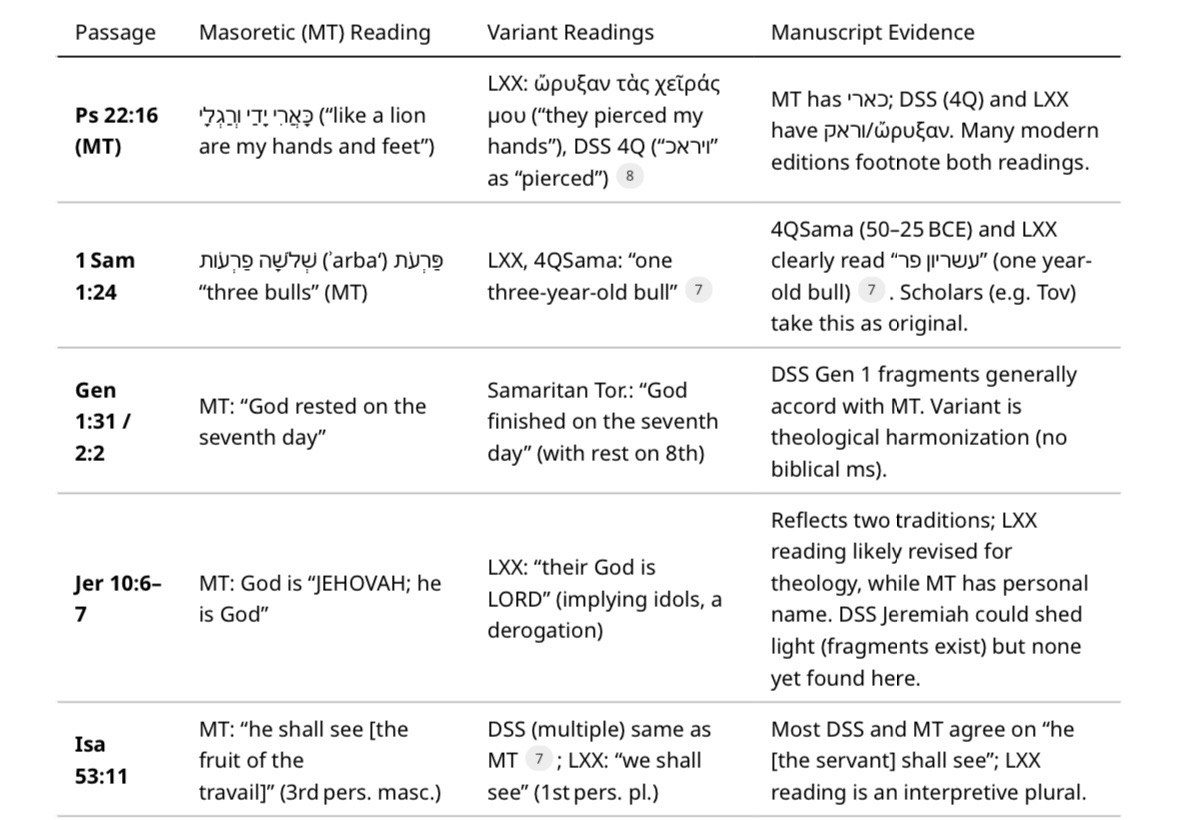
To understand how scholars compare these manuscript traditions, the following abbreviations are commonly used in textual criticism:
- MT – Masoretic Text
- DSS – Dead Sea Scrolls
- LXX – Septuagint
- Sam – Samaritan Pentateuch
“In the next blog, we would talk about textual criticism of the Hebrew Bible, so do well to read about that too.” — Angel Kanu
Frequently Asked Questions
Why is part of the Old Testament written in Aramaic?
When the Babylonians conquered Judah in 586 BC and carried the Jews into exile, the Jews adopted Aramaic — the language of the Babylonian empire. Parts of Daniel and Ezra, and the verse Jeremiah 10:11, were written in Aramaic during or after this period. The Medo-Persian Empire that followed Babylon also used Aramaic as its official language, further reinforcing its use among the Jewish community.
What is the Septuagint and why was it created?
The Septuagint is the Greek translation of the Hebrew scriptures. It was created because Jews living outside Judea — particularly in Alexandria, Egypt — had lost their native Hebrew under the influence of Hellenistic culture following Alexander the Great’s conquests. The word Septuagint means “seventy” (LXX), and according to legend about 72 Jewish translators independently produced identical translations. It also included additional Jewish writings not in the original Hebrew canon, known as the deuterocanonical books.
What criteria did the Jews use to compile the Hebrew Bible?
The Jewish criteria for including a book in the Hebrew Bible (Tanakh) included attribution to a prophet or king, consistency with the Torah, antiquity, and liturgical usage — whether the book had already been used in Jewish worship and community life. These criteria guided the compilation process from approximately 450 BC to 100 AD.
What is the Masoretic Text?
Ancient Hebrew writings used consonants only — they did not write vowels. Between the 7th and 10th centuries AD, Jewish scribes known as the Masoretes added vowel markings, pronunciation guides, accent marks, and copying notes to the Hebrew Bible, producing the Masoretic Text. The oldest known complete copy is the Leningrad Codex (1009 CE), with the Aleppo Codex (around 930 CE) being slightly older but partially damaged.
What did the Dead Sea Scrolls reveal about Old Testament preservation?
The Dead Sea Scrolls, discovered in 1947 at Qumran near the Dead Sea, include manuscript fragments of every Old Testament book except Esther, dated roughly from 250 BCE to 70 CE. Scholars report about 95% agreement with the later Masoretic tradition — differences are minor (spelling variations, word order, scribal slips) and do not substantially change meaning. They push the manuscript record back over 1,000 years before the Leningrad Codex, confirming remarkable faithfulness in transmission.